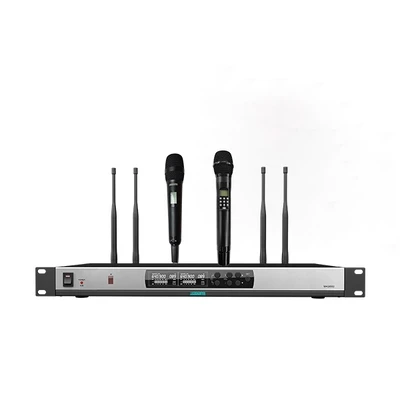

DSPPA D5821 True Diversity UHF System with 2 Handheld Mics

Click on the image to enlarge it

DSPPA

Click here for more DSPPA

DSPPA D5821 True Diversity UHF System with 2 Handheld Mics


The DSPPA D5821 is a UHF kit with a dual-channel true diversity receiver and two handheld dynamic mics. It fits mosques, schools and event halls where two speakers each need their own cordless mic.

====

The DSPPA D5821 is a UHF wireless kit built around a dual-channel true diversity receiver and two handheld microphones. The receiver offers 200 channels between 632 and 695.25MHz, and each mic runs more than 10 hours on a pair of AA batteries. It is the kit to choose when two people speak at the same event: an imam and a khateeb, a host and a guest, or two teachers at a school ceremony.

DSPPA D5821 key specifications

All figures below come from DSPPA's official datasheet:

  • Frequency range: 632 to 695.25MHz in 250KHz steps, 200 channels.
  • Audio: 120Hz to 15KHz response, signal-to-noise ratio above 70dB, distortion at or below 1%.
  • Receiver sensitivity: -95dBm or better, BNC antenna input at 50 ohms.
  • Transmit power: 14dBm (high) or 6dBm (low).
  • Power: the receiver runs on DC 12V at 600mA; each mic takes two AA alkaline cells.

Why true diversity matters in large rooms

In a big mosque or banquet hall, radio signals bounce off walls and columns. At certain spots the signal fades and you hear a short dropout. A true diversity receiver listens through two antennas and always uses the stronger one, so audio stays steady while the speaker walks across a stage or between rows.

Frequency locking uses a PLL circuit, and pairing is done by infrared. Press the sync button, hold the mic near the IR window on the front panel, and it picks up the receiver channel.

Dynamic handheld mics with long battery life

Each handheld has a dynamic capsule, a built-in antenna with nothing sticking out, and its own small display. At 14dBm it runs for more than 10 hours; switch to 6dBm and you get more than 15 hours. Each mic measures 265mm long, 50mm across, and weighs 0.45kg.

Connecting to a mixer or amplifier

The rear panel has two balanced XLR outputs, one per channel, plus a 6.35mm jack that mixes both channels. A switch sets the mix level to LINE for a mixer line input or MIC (7mV) for an amplifier mic input. Front controls adjust each channel's volume separately, and the screen shows frequency, group and signal strength. At 483mm wide and 44mm high, the receiver matches a 19-inch 1U rack slot.

Where it fits in Saudi Arabia

  • Mosques: one mic for the imam at the mihrab, one for the khateeb or muezzin.
  • Schools: morning assembly broadcasts and stage events.
  • Hotels and wedding halls: the host plus a guest on stage.
  • Training rooms: the trainer and the session moderator.

External antennas for multi-receiver racks

The BNC 50-ohm antenna input and the 632 to 695.25MHz band sit inside the 400 to 950MHz range of the DSPPA D5828 and D5828C antenna amplifiers. When several receivers share one rack, connect them through one of those units so they all use a single antenna pair.

D5821, D5822 or D5824?

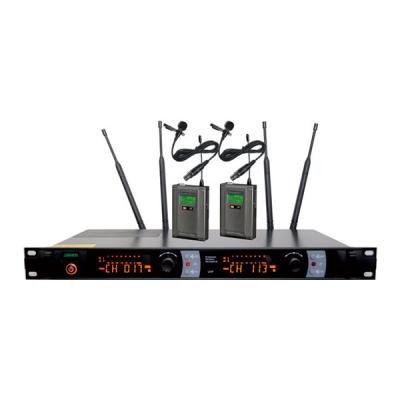
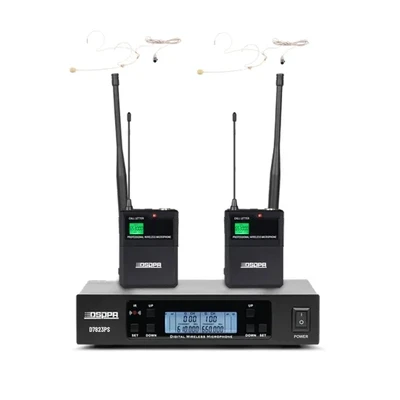
All three kits use the same receiver; the difference is the microphone. The D5821 has handheld mics with built-in antennas and 10+ hours of runtime, for preachers and hosts. The D5822 has lavalier mics with belt-pack transmitters and 8+ hours, for speakers who need their hands free. The D5824 has gooseneck desktop mics that stay on a table or lectern.

Frequently Asked Questions

How long do the DSPPA D5821 mics run on batteries?

More than 10 hours at the 14dBm high-power setting and more than 15 hours at 6dBm, using two AA alkaline cells per mic.

Can I run both mics to one amplifier input?

Yes. The receiver has a 6.35mm mixed output with a LINE/MIC level switch. Each channel also has its own XLR output.

What is the difference between the D5821 and D5822?

They share the same receiver. The D5821 comes with two handheld mics; the D5822 comes with two lavalier mics and belt-pack transmitters.

Specifications

  • Model: D5821
  • System configuration: 1 dual-channel receiver + 2 handheld wireless mics
  • Frequency range: 632-695.25MHz
  • Channels: 200
  • Frequency step: 250KHz
  • Dynamic range: 82dB
  • Max frequency deviation: ±45KHz
  • Audio frequency response: 120Hz-15KHz (±3dB)
  • Signal-to-noise ratio: Greater than 70dB
  • Total harmonic distortion: ≤1%
  • Operating temperature: -10°C to +40°C
  • Antenna interface: BNC / 50Ω
  • Receiver sensitivity: ≤-95dBm
  • Receiver display: Screen showing frequency, group, RF signal and volume level
  • Receiver technology: Dual-channel True Diversity with PLL digital frequency locking and IR frequency pairing
  • Audio outputs: 2 balanced XLR outputs (one per channel) + 6.35mm mixed output for both channels
  • Mixed output level switch: LINE / MIC: 7mV
  • Receiver power supply: DC 12V, 600mA
  • Receiver dimensions: 483×196×44mm
  • Receiver weight: 2.3kg
  • Mic antenna: Built-in PCB antenna
  • Mic capsule: Dynamic
  • RF output power: High 14dBm / Low 6dBm
  • Spurious suppression: -60dB
  • Mic power supply: 2 × AA 1.5V alkaline batteries
  • Battery life: Over 10 hours at 14dBm; over 15 hours at 6dBm
  • Mic display: Yes
  • Mic dimensions: Ø50×265mm
  • Mic weight: 0.45kg

Features

  • 200 UHF channels from 632 to 695.25MHz: pick two clean frequencies away from other wireless gear in the building.
  • Two AA cells per mic: more than 10 hours at 14dBm and more than 15 hours at 6dBm.
  • Two XLR outputs plus a 6.35mm mix out: run each mic to its own mixer channel, or both to an amplifier on one cable.
  • IR pairing for each of the 2 mics: the handheld locks to the receiver channel with one button, no manual tuning.
  • 120Hz to 15KHz response with over 70dB SNR: clear speech for sermons, lectures and stage hosting.
Read more
SKU : DSPPA-D5821

1,687.14

VAT included


The DSPPA D5821 is a UHF kit with a dual-channel true diversity receiver and two handheld dynamic mics. It fits mosques, schools and event halls where two speakers each need their own cordless mic.

====

The DSPPA D5821 is a UHF wireless kit built around a dual-channel true diversity receiver and two handheld microphones. The receiver offers 200 channels between 632 and 695.25MHz, and each mic runs more than 10 hours on a pair of AA batteries. It is the kit to choose when two people speak at the same event: an imam and a khateeb, a host and a guest, or two teachers at a school ceremony.

DSPPA D5821 key specifications

All figures below come from DSPPA's official datasheet:

  • Frequency range: 632 to 695.25MHz in 250KHz steps, 200 channels.
  • Audio: 120Hz to 15KHz response, signal-to-noise ratio above 70dB, distortion at or below 1%.
  • Receiver sensitivity: -95dBm or better, BNC antenna input at 50 ohms.
  • Transmit power: 14dBm (high) or 6dBm (low).
  • Power: the receiver runs on DC 12V at 600mA; each mic takes two AA alkaline cells.

Why true diversity matters in large rooms

In a big mosque or banquet hall, radio signals bounce off walls and columns. At certain spots the signal fades and you hear a short dropout. A true diversity receiver listens through two antennas and always uses the stronger one, so audio stays steady while the speaker walks across a stage or between rows.

Frequency locking uses a PLL circuit, and pairing is done by infrared. Press the sync button, hold the mic near the IR window on the front panel, and it picks up the receiver channel.

Dynamic handheld mics with long battery life

Each handheld has a dynamic capsule, a built-in antenna with nothing sticking out, and its own small display. At 14dBm it runs for more than 10 hours; switch to 6dBm and you get more than 15 hours. Each mic measures 265mm long, 50mm across, and weighs 0.45kg.

Connecting to a mixer or amplifier

The rear panel has two balanced XLR outputs, one per channel, plus a 6.35mm jack that mixes both channels. A switch sets the mix level to LINE for a mixer line input or MIC (7mV) for an amplifier mic input. Front controls adjust each channel's volume separately, and the screen shows frequency, group and signal strength. At 483mm wide and 44mm high, the receiver matches a 19-inch 1U rack slot.

Where it fits in Saudi Arabia

  • Mosques: one mic for the imam at the mihrab, one for the khateeb or muezzin.
  • Schools: morning assembly broadcasts and stage events.
  • Hotels and wedding halls: the host plus a guest on stage.
  • Training rooms: the trainer and the session moderator.

External antennas for multi-receiver racks

The BNC 50-ohm antenna input and the 632 to 695.25MHz band sit inside the 400 to 950MHz range of the DSPPA D5828 and D5828C antenna amplifiers. When several receivers share one rack, connect them through one of those units so they all use a single antenna pair.

D5821, D5822 or D5824?

All three kits use the same receiver; the difference is the microphone. The D5821 has handheld mics with built-in antennas and 10+ hours of runtime, for preachers and hosts. The D5822 has lavalier mics with belt-pack transmitters and 8+ hours, for speakers who need their hands free. The D5824 has gooseneck desktop mics that stay on a table or lectern.

Frequently Asked Questions

How long do the DSPPA D5821 mics run on batteries?

More than 10 hours at the 14dBm high-power setting and more than 15 hours at 6dBm, using two AA alkaline cells per mic.

Can I run both mics to one amplifier input?

Yes. The receiver has a 6.35mm mixed output with a LINE/MIC level switch. Each channel also has its own XLR output.

What is the difference between the D5821 and D5822?

They share the same receiver. The D5821 comes with two handheld mics; the D5822 comes with two lavalier mics and belt-pack transmitters.

Specifications

  • Model: D5821
  • System configuration: 1 dual-channel receiver + 2 handheld wireless mics
  • Frequency range: 632-695.25MHz
  • Channels: 200
  • Frequency step: 250KHz
  • Dynamic range: 82dB
  • Max frequency deviation: ±45KHz
  • Audio frequency response: 120Hz-15KHz (±3dB)
  • Signal-to-noise ratio: Greater than 70dB
  • Total harmonic distortion: ≤1%
  • Operating temperature: -10°C to +40°C
  • Antenna interface: BNC / 50Ω
  • Receiver sensitivity: ≤-95dBm
  • Receiver display: Screen showing frequency, group, RF signal and volume level
  • Receiver technology: Dual-channel True Diversity with PLL digital frequency locking and IR frequency pairing
  • Audio outputs: 2 balanced XLR outputs (one per channel) + 6.35mm mixed output for both channels
  • Mixed output level switch: LINE / MIC: 7mV
  • Receiver power supply: DC 12V, 600mA
  • Receiver dimensions: 483×196×44mm
  • Receiver weight: 2.3kg
  • Mic antenna: Built-in PCB antenna
  • Mic capsule: Dynamic
  • RF output power: High 14dBm / Low 6dBm
  • Spurious suppression: -60dB
  • Mic power supply: 2 × AA 1.5V alkaline batteries
  • Battery life: Over 10 hours at 14dBm; over 15 hours at 6dBm
  • Mic display: Yes
  • Mic dimensions: Ø50×265mm
  • Mic weight: 0.45kg

Features

  • 200 UHF channels from 632 to 695.25MHz: pick two clean frequencies away from other wireless gear in the building.
  • Two AA cells per mic: more than 10 hours at 14dBm and more than 15 hours at 6dBm.
  • Two XLR outputs plus a 6.35mm mix out: run each mic to its own mixer channel, or both to an amplifier on one cable.
  • IR pairing for each of the 2 mics: the handheld locks to the receiver channel with one button, no manual tuning.
  • 120Hz to 15KHz response with over 70dB SNR: clear speech for sermons, lectures and stage hosting.

See more View less