
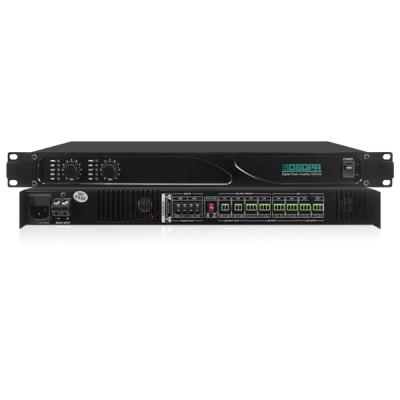
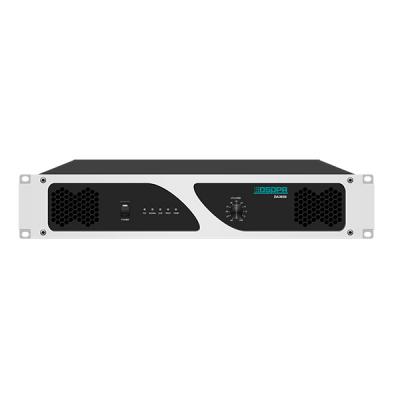
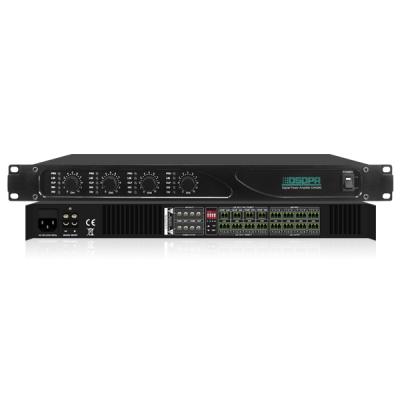

The DSPPA DA2250 is a 2-channel Class-D power amplifier delivering 250W per channel on 70V or 100V speaker lines, built into a 1U rack chassis. It fits mosques, schools and commercial buildings that need two speaker zones with separate volume, and it can also run from a 24V DC supply.
====
The DSPPA DA2250 is a Class-D digital power amplifier with two independent channels, each rated at 250W into a 70V or 100V speaker line. It is housed in a 1U, 19-inch rack chassis and runs from AC 180-250V or from a 24V DC supply. For a mosque that needs one line for the prayer hall and another for the outdoor horns, or a school that keeps classroom audio apart from the yard, one DA2250 covers both zones.
DSPPA DA2250 key specifications
The DA2250 belongs to DSPPA's DA series of 2-channel and 4-channel amplifiers. All models share the same chassis and inputs; they differ in power and channel count.
- Channels: 2, rated at 250W each.
- Output: 70V or 100V, chosen with a rear-panel switch.
- Frequency response: 80 Hz to 15 kHz; THD below 0.3% at 1 kHz.
- Signal-to-noise ratio: above 80 dB.
- Power draw: 610W on AC 220V, 350.4W on 24V DC.
Two zones, two volume knobs
Each channel has its own front-panel volume control. Turn up the outdoor horns for the adhan without making the prayer hall louder. Load each channel with speakers totalling no more than 250W: forty 6W ceiling speakers draw 240W and stay inside the limit. A balanced line output on the back passes the signal to a second amplifier when you expand the system.
Paging priority over background music
The rear panel carries two priority inputs: a balanced line input that triggers above 10 mVp and an unbalanced 100V input that triggers above 1000 mVp. When a priority signal arrives, the normal input is muted, and it comes back 2-3 seconds after the announcement ends. In a mall or warehouse playing background music, urgent calls cut through without anyone touching the mixer.
24V DC operation and protection
Besides mains power, the DA2250 accepts 24V DC, so it can sit on a battery backup and keep the system talking during a power cut. DSPPA rates DC output 3 dB below the AC figure. Protection covers power-on surge, high temperature, DC on the output and short circuits. The LIM indicator shows the limiter at work: after 2-4 seconds at or above rated power, output is halved to spare the speakers.
Where the DA2250 fits in Saudi Arabia
- Mosques: one channel for ceiling speakers inside, one for outdoor horns.
- Schools: classrooms and corridors on one channel, the yard and morning assembly on the other.
- Warehouses and factories: staff paging over long 100V cable runs.
- Hotels and event halls: two background music zones with priority for announcements.
What feeds the DA2250
This is a power amplifier, so its inputs take line-level audio at 775 mVRMS sensitivity; the datasheet lists no microphone input. Put a preamplifier or mixer in front of it, such as the DSPPA MP9811P with five mic inputs. Line connections use HT-3.81 Phoenix terminals, and the speaker output uses a covered 7.62-4P socket.
DA2250, DA2500 or DA4125?
All three share the 1U chassis, the same inputs and 24V DC support. The DA2500 doubles output to 500W per channel and draws 1270W, so pick it when any zone carries more than 250W of speakers. The DA4125 gives you four 120W channels instead, a better match for four small zones than two large ones.
Frequently Asked Questions
How many speakers can the DSPPA DA2250 drive?
Keep the total speaker wattage on each channel at or below 250W. With 6W ceiling speakers that is up to 40 per channel, about 80 across both.
Can I plug a microphone straight into the DA2250?
No. Its inputs are line level and the datasheet lists no mic input. Connect microphones to a preamplifier or mixer such as the DSPPA MP9811P, then feed its output to the amplifier.
Does the DA2250 work during a power cut?
It accepts a 24V DC supply alongside AC, so with backup batteries it keeps running at a rated output 3 dB lower, per the datasheet.
Specifications
- Model: DA2250
- Type: Class-D digital power amplifier
- Series: DSPPA DA 2-/4-channel series with DC 24V (DA2125, DA2250, DA2500, DA4060, DA4125, DA4250)
- Channels: 2
- Rated power per channel: 250W
- Speaker line output: 70V or 100V via rear selector switch
- Input sensitivity: 775 mVRMS (0 dBV, all balanced inputs); 100 VRMS (100V unbalanced input)
- Input impedance: 60 kΩ (balanced); 20 kΩ (balanced priority); 100 kΩ (100V unbalanced)
- SNR: >80 dB (at 100 VRMS output)
- Channel separation: >70 dB (1 kHz)
- Frequency response: 80 Hz to 15 kHz (±3 dB, normal operation)
- THD: <0.3% (1 kHz)
- Slew rate: >29 V/µs
- Priority threshold: >10 mVp (balanced priority input); >1000 mVp (100 VRMS priority input)
- Inputs: Balanced line input, balanced priority input, 100 VRMS unbalanced priority input (HT-3.81 Phoenix connectors)
- Outputs: Balanced line output to another amplifier (Phoenix); 70V/100V speaker output on 7.62-4P fence socket with cover
- Front panel controls: Volume knob per channel, power switch with indicator
- Indicators: 5 LED indicators: PRO, LIM, CLP, SIG, 70V
- Protection: Power-on, high temperature, DC, short circuit, plus voltage-limit circuit
- Power supply: AC 180-250V, 50/60 Hz; or DC 24V (rated output -3 dB)
- Power stage: Switching power supply with active PFC
- Cooling: Temperature-controlled fan
- Power consumption (AC 220V): 610W
- Power consumption (DC 24V): 350.4W
- Static consumption (AC 220V): 38W
- Static consumption (DC 24V): 38.4W
- Chassis dimensions: 483 × 435 × 44 mm (without feet), 1U
- Feet: 4 removable 6.5 mm soft plastic feet
- Net weight: 6.4 kg
Features
- 2 channels at 250W each: run two speaker zones, each with its own front-panel volume knob.
- 70V or 100V output, selected by a rear switch: long cable runs and dozens of speakers on one line.
- 24V DC input alongside AC 180-250V: audio keeps going on backup batteries at 3 dB lower rated power.
- 2 priority inputs (balanced and 100V): announcements mute the music automatically, which returns 2-3 seconds later.
- 1U chassis, 6.4 kg net: takes one unit of a 19-inch rack, cooled by a temperature-controlled fan.