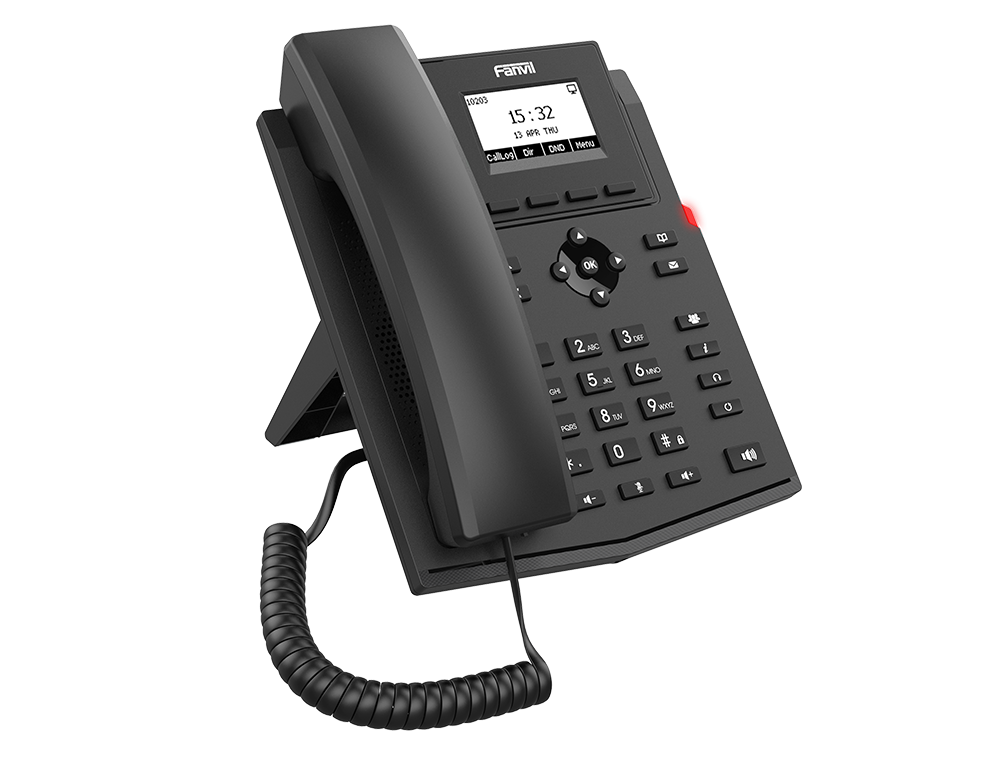
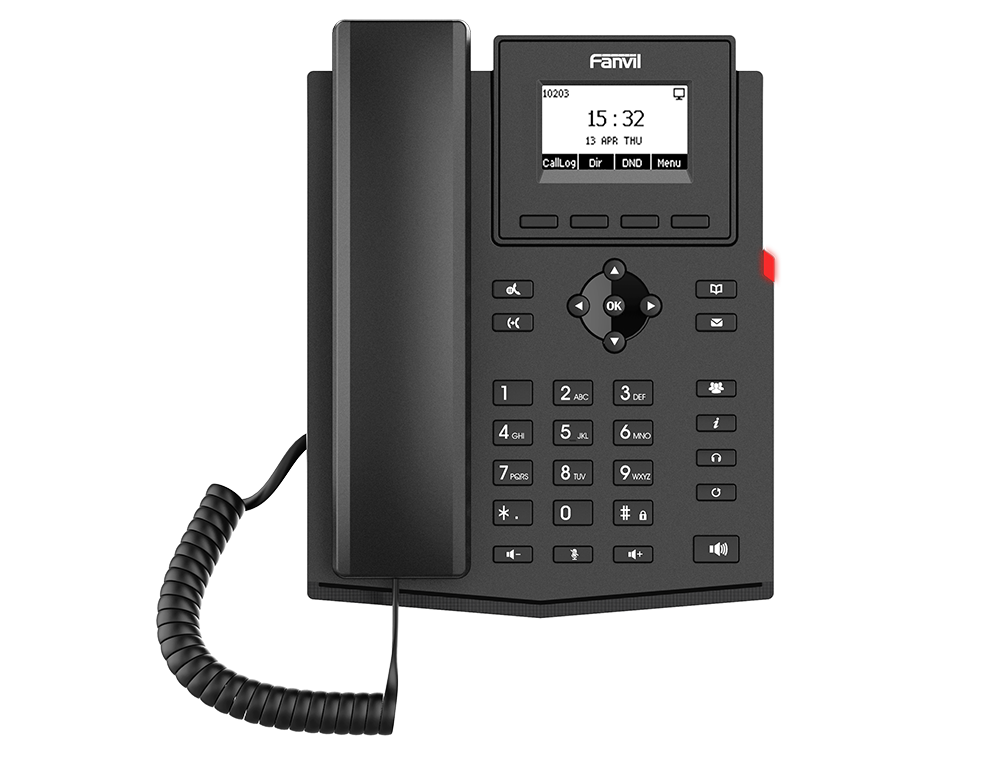
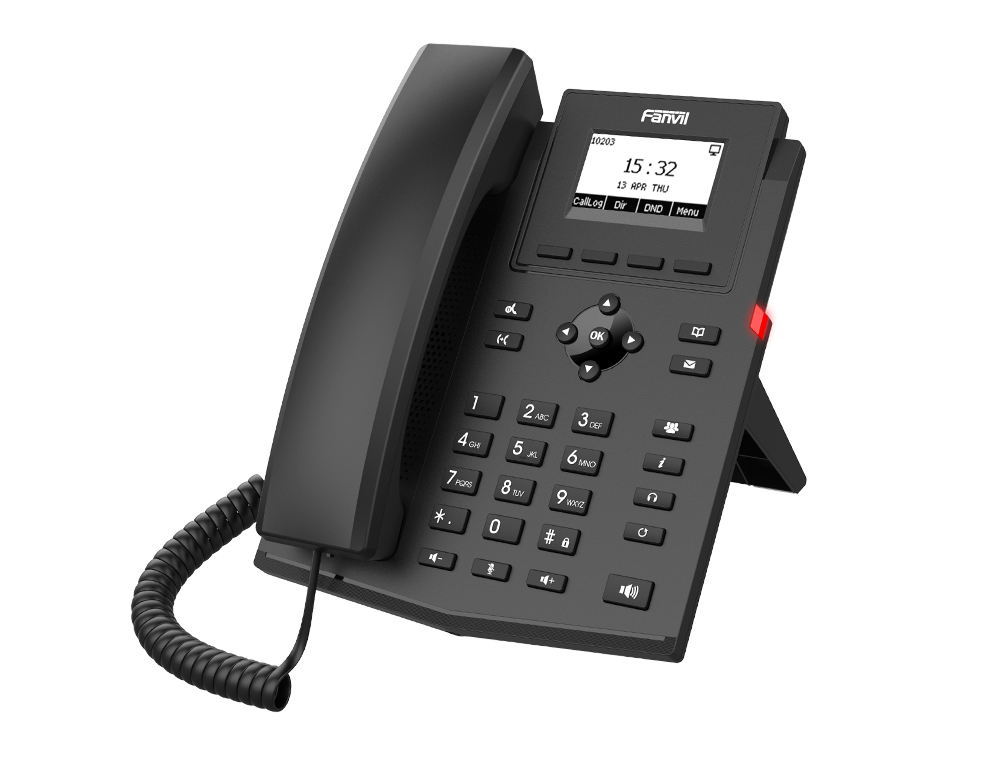

Fanvil X301G Entry-Level Gigabit IP Phone with 2 SIP Lines

Click on the image to enlarge it

Fanvil

Click here for more Fanvil

Fanvil X301G Entry-Level Gigabit IP Phone with 2 SIP Lines


The Fanvil X301G is the gigabit model of the X301 range, with dual 10/100/1000 Mbps ports, built-in PoE, 2 SIP lines and a 2.3-inch display. It is meant for offices on a gigabit network that want an affordable phone without throttling the PC connected behind it.

====

The Fanvil X301G is a 2-line desk phone with dual gigabit ports, built for offices whose network already runs at 1000 Mbps and where the PC is daisy-chained through the phone. Fanvil positions it as its entry-level gigabit SIP phone, and it powers up straight from a PoE switch, so there is no adapter on the desk. The box holds the handset and cord, a 1.5 m CAT5e cable and the desk stand.

Why pick a gigabit phone like the Fanvil X301G?

Most desks get one network drop. The cable goes into the phone, and the phone's second port feeds the computer. On a 10/100 phone that caps the PC at 100 Mbps. Both ports on the X301G run at 10/100/1000 Mbps, so the computer keeps its full gigabit link. That matters for engineering and design teams, finance departments pushing large files to a server, and anyone working off network drives all day.

Main specifications

  • 2 SIP lines and local 6-way conferencing.
  • 2.3-inch backlit graphic display.
  • Two gigabit RJ45 ports with integrated PoE, drawing 1.25 to 1.86 W.
  • HD codecs G.722 and Opus, plus G.711, G.729 and iLBC.
  • 1,000 local contacts plus 1,000 from an XML or LDAP directory.
  • Desk stand with 45° and 50° positions; wall mounting optional.

Network security for branches and remote staff

VLAN and QoS keep voice traffic separate from PC data and give calls priority, while 802.1x checks devices before they join the network. Built-in L2TP and OpenVPN let a branch office or a home worker register the phone on the head office PBX through an encrypted tunnel. Calls themselves are protected with TLS signaling and SRTP media.

Clear audio and dedicated keys

HD audio runs on both the handset and the speakerphone with 16 kHz sampling, echo cancellation, noise reduction and automatic gain control. Nine dedicated function keys cover hold, transfer, conference, redial, voicemail and the phonebook, so new staff pick it up in minutes. The call log keeps the last 600 incoming, outgoing and missed calls, which makes it easy to call back a customer from this morning.

Typical deployments in KSA

  • Engineering and consulting offices in Riyadh and Al Khobar on gigabit LANs.
  • Admin departments in hospitals and universities.
  • Small customer service teams using a wired RJ9 headset or an EHS wireless headset.
  • Branch offices tied back to headquarters over VPN.

Compatibility and provisioning

The phone works with SIP-based PBXs, and Fanvil's official compatibility list names the X301 series on Yeastar P-Series, 3CX, FreePBX, PortSIP and others. Configure it through the web interface, or let it pull its settings automatically via DHCP Option 66, SIP PnP or TR-069.

X301G vs X301P vs X303G

The X301G and X301P share the same screen, SIP accounts and keypad. The only difference is that the X301G has gigabit ports while the X301P has 10/100 Mbps ports. If you also want a 2.4-inch 320x240 color screen, 4 SIP accounts and 3 LED line keys while keeping gigabit networking, step up to the X303G.

Frequently Asked Questions

What is the difference between the Fanvil X301G and X301P?

Port speed only: the X301G has two gigabit 10/100/1000 Mbps ports, the X301P two 10/100 Mbps ports. Screen, lines and keys are identical.

Does the X301G need a power adapter?

Not on a PoE switch, since it is powered over the network cable. A 5V/0.6A adapter is optional and not in the box.

Can I use the X301G at a remote branch?

Yes. It supports L2TP and OpenVPN, so it can register to the head office PBX through an encrypted tunnel.

Specifications

  • Model: X301G
  • Series: Fanvil X300 Series (Entry Level)
  • Display: 2.3-inch backlit graphic (dot-matrix) LCD
  • SIP lines: 2
  • Audio conference: Up to 6 parties (local conference)
  • Keys: 33 keys: 4 soft keys, 9 function keys, 4 navigation keys + OK, 12 dialpad keys, 3 volume keys (up, down, mute)
  • Function keys: Hold, Transfer, Voice message, Conference, Phonebook, MWI, Headset, Redial, Hands-free
  • LED indicators: 1 red status indicator
  • Codecs: G.711a/u, G.723.1, G.726, G.729A/B, iLBC; wideband G.722 and Opus
  • Audio processing: HD handset and speaker (16 kHz sampling), full-duplex AEC, VAD, CNG, BNE, noise reduction, AGC, PLC, adaptive jitter buffer
  • DTMF: In-band, RFC2833, SIP INFO
  • Network ports: 2x RJ45 10/100/1000 Mbps (Network + PC, bridged)
  • PoE: Integrated
  • Headset support: RJ9 port; EHS wireless headsets: Plantronics via APD-80 cable, Jabra via Fanvil EHS20 cable
  • Protocols: SIP 2.0 over UDP/TCP/TLS, RTP/RTCP/SRTP, STUN, DHCP, PPPoE, SNTP, FTP/TFTP, HTTP/HTTPS, TR-069, AES128/AES256 encryption
  • Network features: IPv4/IPv6, static/DHCP/PPPoE, VLAN, QoS, LLDP, 802.1x, VPN (L2TP, OpenVPN), RTCP-XR and VQ-RTCPXR
  • Management: Auto provisioning via FTP/TFTP/HTTP/HTTPS, DHCP Option 66, SIP PnP, TR-069; web portal; web packet capture; config and phonebook import/export; firmware upgrade; Syslog; Action URL; uaCSTA
  • Phonebook: 1,000 local + 1,000 remote (XML/LDAP) entries
  • Call log: 600 entries (in, out, missed)
  • Call features: Attended/blind transfer, call forward (always, busy, no answer), call waiting, call park/pickup (server-dependent), DND, auto-answer, intercom, hotline, hot desking, block/allow list, voicemail and recording via server
  • Installation: Desktop stand at 45° or 50°; wall mount optional
  • Dimensions: 169x201.1x177.4 mm (45° stand); 169x191.9x185.8 mm (50° stand); 169x120.1x213.7 mm (wall mounted)
  • Other interfaces: RJ9 handset port, RJ9 headset port, security slot
  • Color: Black
  • Operating environment: 0 to 45°C, 10 to 95% humidity
  • Power: PoE, or optional external DC 5V/0.6A adapter
  • Power consumption: 0.8 to 1.29 W (adapter); 1.25 to 1.86 W (PoE)
  • Packaging: Gift box 250x220x55 mm; carton of 10: 460x300x270 mm, 8.55 kg net / 9.26 kg gross
  • In the box: Phone with handset, RJ9 handset cord, 1.5 m CAT5e Ethernet cable, desktop stand (no power adapter listed)

Features

  • Dual gigabit 10/100/1000 Mbps ports: the PC behind the phone keeps its full gigabit link.
  • Built-in PoE drawing 1.25 to 1.86 W: runs from a PoE switch with no desk adapter.
  • 2 SIP lines and 6-way conferencing: one number for your extension and another for a team or branch line.
  • L2TP and OpenVPN: remote staff and branch phones reach the PBX over an encrypted tunnel.
  • EHS wireless headset support: agents answer from a Plantronics or Jabra headset away from the desk.
Read more
SKU : FANVIL-X301G

197.80

VAT included


The Fanvil X301G is the gigabit model of the X301 range, with dual 10/100/1000 Mbps ports, built-in PoE, 2 SIP lines and a 2.3-inch display. It is meant for offices on a gigabit network that want an affordable phone without throttling the PC connected behind it.

====

The Fanvil X301G is a 2-line desk phone with dual gigabit ports, built for offices whose network already runs at 1000 Mbps and where the PC is daisy-chained through the phone. Fanvil positions it as its entry-level gigabit SIP phone, and it powers up straight from a PoE switch, so there is no adapter on the desk. The box holds the handset and cord, a 1.5 m CAT5e cable and the desk stand.

Why pick a gigabit phone like the Fanvil X301G?

Most desks get one network drop. The cable goes into the phone, and the phone's second port feeds the computer. On a 10/100 phone that caps the PC at 100 Mbps. Both ports on the X301G run at 10/100/1000 Mbps, so the computer keeps its full gigabit link. That matters for engineering and design teams, finance departments pushing large files to a server, and anyone working off network drives all day.

Main specifications

  • 2 SIP lines and local 6-way conferencing.
  • 2.3-inch backlit graphic display.
  • Two gigabit RJ45 ports with integrated PoE, drawing 1.25 to 1.86 W.
  • HD codecs G.722 and Opus, plus G.711, G.729 and iLBC.
  • 1,000 local contacts plus 1,000 from an XML or LDAP directory.
  • Desk stand with 45° and 50° positions; wall mounting optional.

Network security for branches and remote staff

VLAN and QoS keep voice traffic separate from PC data and give calls priority, while 802.1x checks devices before they join the network. Built-in L2TP and OpenVPN let a branch office or a home worker register the phone on the head office PBX through an encrypted tunnel. Calls themselves are protected with TLS signaling and SRTP media.

Clear audio and dedicated keys

HD audio runs on both the handset and the speakerphone with 16 kHz sampling, echo cancellation, noise reduction and automatic gain control. Nine dedicated function keys cover hold, transfer, conference, redial, voicemail and the phonebook, so new staff pick it up in minutes. The call log keeps the last 600 incoming, outgoing and missed calls, which makes it easy to call back a customer from this morning.

Typical deployments in KSA

  • Engineering and consulting offices in Riyadh and Al Khobar on gigabit LANs.
  • Admin departments in hospitals and universities.
  • Small customer service teams using a wired RJ9 headset or an EHS wireless headset.
  • Branch offices tied back to headquarters over VPN.

Compatibility and provisioning

The phone works with SIP-based PBXs, and Fanvil's official compatibility list names the X301 series on Yeastar P-Series, 3CX, FreePBX, PortSIP and others. Configure it through the web interface, or let it pull its settings automatically via DHCP Option 66, SIP PnP or TR-069.

X301G vs X301P vs X303G

The X301G and X301P share the same screen, SIP accounts and keypad. The only difference is that the X301G has gigabit ports while the X301P has 10/100 Mbps ports. If you also want a 2.4-inch 320x240 color screen, 4 SIP accounts and 3 LED line keys while keeping gigabit networking, step up to the X303G.

Frequently Asked Questions

What is the difference between the Fanvil X301G and X301P?

Port speed only: the X301G has two gigabit 10/100/1000 Mbps ports, the X301P two 10/100 Mbps ports. Screen, lines and keys are identical.

Does the X301G need a power adapter?

Not on a PoE switch, since it is powered over the network cable. A 5V/0.6A adapter is optional and not in the box.

Can I use the X301G at a remote branch?

Yes. It supports L2TP and OpenVPN, so it can register to the head office PBX through an encrypted tunnel.

Specifications

  • Model: X301G
  • Series: Fanvil X300 Series (Entry Level)
  • Display: 2.3-inch backlit graphic (dot-matrix) LCD
  • SIP lines: 2
  • Audio conference: Up to 6 parties (local conference)
  • Keys: 33 keys: 4 soft keys, 9 function keys, 4 navigation keys + OK, 12 dialpad keys, 3 volume keys (up, down, mute)
  • Function keys: Hold, Transfer, Voice message, Conference, Phonebook, MWI, Headset, Redial, Hands-free
  • LED indicators: 1 red status indicator
  • Codecs: G.711a/u, G.723.1, G.726, G.729A/B, iLBC; wideband G.722 and Opus
  • Audio processing: HD handset and speaker (16 kHz sampling), full-duplex AEC, VAD, CNG, BNE, noise reduction, AGC, PLC, adaptive jitter buffer
  • DTMF: In-band, RFC2833, SIP INFO
  • Network ports: 2x RJ45 10/100/1000 Mbps (Network + PC, bridged)
  • PoE: Integrated
  • Headset support: RJ9 port; EHS wireless headsets: Plantronics via APD-80 cable, Jabra via Fanvil EHS20 cable
  • Protocols: SIP 2.0 over UDP/TCP/TLS, RTP/RTCP/SRTP, STUN, DHCP, PPPoE, SNTP, FTP/TFTP, HTTP/HTTPS, TR-069, AES128/AES256 encryption
  • Network features: IPv4/IPv6, static/DHCP/PPPoE, VLAN, QoS, LLDP, 802.1x, VPN (L2TP, OpenVPN), RTCP-XR and VQ-RTCPXR
  • Management: Auto provisioning via FTP/TFTP/HTTP/HTTPS, DHCP Option 66, SIP PnP, TR-069; web portal; web packet capture; config and phonebook import/export; firmware upgrade; Syslog; Action URL; uaCSTA
  • Phonebook: 1,000 local + 1,000 remote (XML/LDAP) entries
  • Call log: 600 entries (in, out, missed)
  • Call features: Attended/blind transfer, call forward (always, busy, no answer), call waiting, call park/pickup (server-dependent), DND, auto-answer, intercom, hotline, hot desking, block/allow list, voicemail and recording via server
  • Installation: Desktop stand at 45° or 50°; wall mount optional
  • Dimensions: 169x201.1x177.4 mm (45° stand); 169x191.9x185.8 mm (50° stand); 169x120.1x213.7 mm (wall mounted)
  • Other interfaces: RJ9 handset port, RJ9 headset port, security slot
  • Color: Black
  • Operating environment: 0 to 45°C, 10 to 95% humidity
  • Power: PoE, or optional external DC 5V/0.6A adapter
  • Power consumption: 0.8 to 1.29 W (adapter); 1.25 to 1.86 W (PoE)
  • Packaging: Gift box 250x220x55 mm; carton of 10: 460x300x270 mm, 8.55 kg net / 9.26 kg gross
  • In the box: Phone with handset, RJ9 handset cord, 1.5 m CAT5e Ethernet cable, desktop stand (no power adapter listed)

Features

  • Dual gigabit 10/100/1000 Mbps ports: the PC behind the phone keeps its full gigabit link.
  • Built-in PoE drawing 1.25 to 1.86 W: runs from a PoE switch with no desk adapter.
  • 2 SIP lines and 6-way conferencing: one number for your extension and another for a team or branch line.
  • L2TP and OpenVPN: remote staff and branch phones reach the PBX over an encrypted tunnel.
  • EHS wireless headset support: agents answer from a Plantronics or Jabra headset away from the desk.

See more View less