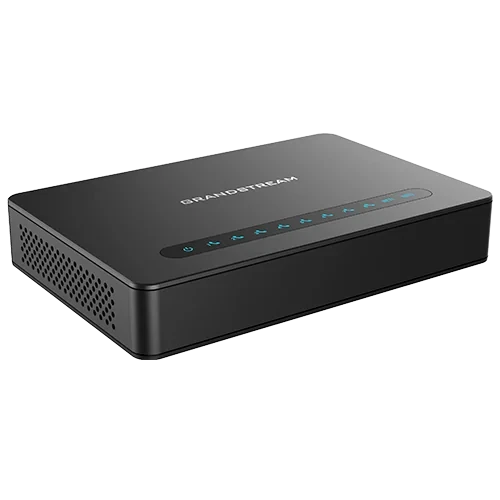
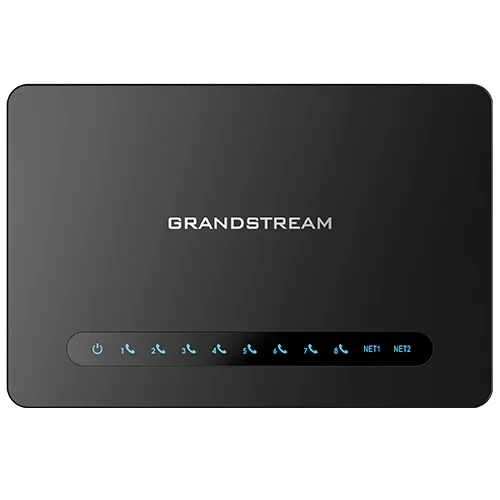
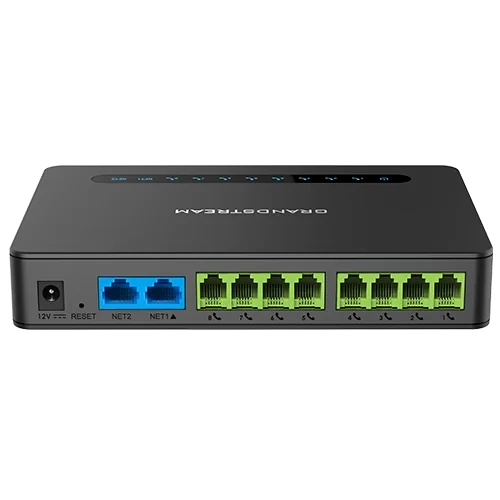

Grandstream HT818 V2 8-Port FXS ATA with Gigabit NAT Router

Click on the image to enlarge it

Grandstream

Click here for more Grandstream

Grandstream HT818 V2 8-Port FXS ATA with Gigabit NAT Router


The Grandstream HT818 V2 puts up to 8 analog phones or fax machines on an IP PBX or SIP provider, with two Gigabit ports and a built-in NAT router. It suits hotels, schools and offices moving to IP telephony that want to keep the handsets they already own.

====

The Grandstream HT818 V2 is a compact 8-port analog telephone adapter that turns ordinary phones into extensions on an IP PBX. Plug it into the office network, run RJ11 cables to your analog handsets and fax machines, and each port registers its own account on the PBX or with a SIP provider. It is built for teams moving to IP telephony that do not want to throw away dozens of phones that still work.

Grandstream HT818 V2 key specs

  • 8 RJ11 FXS ports.
  • Two 10/100/1000 Mbps network ports with a built-in NAT router.
  • 2 SIP profiles, with automatic failover to a backup SIP server.
  • T.38 fax up to 14.4 kbps.
  • 12V/1.5A power adapter.

Eight analog phones, one PBX

Every FXS port behaves like its own extension: it has a number, takes calls, transfers them and puts them on hold just like an IP phone. Caller ID works in Bellcore, ETSI, BT and other formats, and each port supports call waiting, blind and attended transfer, do not disturb and 3-way conferencing. With a 2 REN ring load over up to 1 km of 24 AWG cable, phones can sit in rooms well away from the network cabinet.

Gigabit networking and fax over IP

NET1 acts as the WAN port by default and picks up an address from your router, while NET2 serves as a LAN port that hands out addresses. You can swap their roles in the settings. If a PC or printer sits next to the unit, connect it to the second port instead of pulling another cable from the switch. Fax runs over T.38 and drops back to G.711 pass-through automatically when the far end does not support T.38, useful for offices that still receive purchase orders or reports by fax.

Encryption and central management

Voice is encrypted with SRTP and signaling with TLS and SIPS, and each unit carries its own security certificate with AES encryption. IT can provision it through TR-069 or XML files and manage it from Grandstream's GDMS cloud platform, which handles firmware upgrades and monitoring for many units from one dashboard. GR-909 line testing helps a technician track down faults on the phone wiring.

Where it fits in Saudi Arabia

  • Hotels and serviced apartments with an analog phone in every room.
  • Schools: admin office phones, the guard room and the fax machine.
  • Warehouses and factories with wall-mounted analog phones in aisles and at loading bays.
  • Offices migrating an old phone system to an IP PBX in stages.

PBX compatibility

The HT818 V2 works with any PBX or service provider that supports SIP, including Yeastar P-Series systems. On Grandstream UCM PBXs it supports zero-configuration provisioning: the PBX detects the adapter and assigns extensions to its ports without manual setup.

HT818 V2, GXW4216 or HT841?

The HT818 V2 gives you 8 FXS ports; if you need more, the GXW4216 gateway packs 16 FXS ports into one unit. The HT841 works the other way round: its FXO ports take in STC landlines and feed them into the PBX, while the HT818 V2 connects the phones themselves. Many offices end up using both.

Frequently Asked Questions

How many phones can I connect to the HT818 V2?

Eight analog phones or fax machines, one per FXS port, and each port works as its own extension on the PBX.

Does it work with a Yeastar PBX or a SIP provider?

Yes. It works with any SIP PBX or provider, and supports zero-config provisioning on Grandstream UCM systems.

Can I plug an STC landline into the HT818 V2?

No. Its FXS ports are for phones and fax machines. To bring landlines into a PBX you need an FXO gateway such as the Grandstream HT841 or HT881.

Specifications

  • Model: HT818 V2
  • Series: HT81x V2 (HT812 V2 / HT814 V2 / HT818 V2)
  • Type: 8-port FXS analog telephone adapter
  • Telephone interfaces: 8 × RJ11 FXS ports
  • Network interfaces: 2 × 10/100/1000 Mbps RJ45 (NET1 WAN by default, NET2 LAN by default)
  • Router: Integrated NAT router
  • SIP profiles: 2 SIP profiles across the 8 FXS ports
  • LED indicators: POWER, NET1, NET2, PHONE1–PHONE8
  • Factory reset: Yes (hold 7 seconds)
  • Telephony features: Caller ID display or block, call waiting, flash, blind or attended transfer, forward, hold, DND, 3-way conference
  • Voice codecs: G.711 (PLC, VAD/CNG), G.722, G.723.1, G.729A/B, G.726-32, iLBC, Opus, dynamic jitter buffer, line echo cancellation
  • Fax over IP: T.38 Group 3 relay up to 14.4 kbps, auto switch to G.711 pass-through
  • Ring load: 2 REN, up to 1 km on 24 AWG
  • Caller ID: Bellcore Type 1 & 2, ETSI, BT, NTT, DTMF-based
  • Dial methods: DTMF, pulse
  • Disconnect methods: Busy tone, polarity reversal/wink, loop current
  • Network protocols: TCP/IP/UDP, RTP/RTCP, HTTP/HTTPS, ARP/RARP, ICMP, DNS, DHCP, NTP, TFTP, SSH, Telnet, STUN, SIP, SIP over TCP/TLS, SRTP, SNMP, TR-069, IMS/3GPP, IPoE
  • QoS: Layer 2 (802.1Q VLAN, 802.1p), Layer 3 (ToS, DiffServ, MPLS), traffic shaping
  • DTMF methods: In-audio, RFC 2833, SIP INFO
  • Provisioning and control: HTTP, HTTPS, FTP, FTPS, SSH, TFTP, TR-069, syslog, XML files, zero-config with UCM PBXs
  • Management: Syslog, SSH, web browser, GDMS cloud platform
  • Security: SRTP media; TLS, SIPS and HTTPS control; AES with per-unit security certificate
  • Other features: Failover SIP server, GR-909 line testing, wideband HD codec
  • Power: Universal power supply: input 100–240 VAC, 50–60 Hz; output 12 V / 1.5 A
  • Operating temperature: 0–40°C (32–104°F)
  • Storage temperature: -10 to 60°C (14–140°F)
  • Humidity: 10–90% non-condensing
  • Compliance: FCC, CE, RCM
  • In the box: Unit and power adapter

Features

  • 8 RJ11 FXS ports: connect 8 analog phones or fax machines, each one its own extension on the PBX.
  • Dual 10/100/1000 Mbps ports with NAT router: share the uplink with one more device, no extra switch cable.
  • T.38 fax up to 14.4 kbps: automatic fallback to G.711 pass-through when the far end lacks T.38.
  • 3-way conferencing on every port: an analog handset user can bridge two other parties.
  • 2 REN ring load up to 1 km on 24 AWG: reach phones in rooms far from the network cabinet.
Read more
SKU : GRANDSTREAM-HT818-V2

483

VAT included


The Grandstream HT818 V2 puts up to 8 analog phones or fax machines on an IP PBX or SIP provider, with two Gigabit ports and a built-in NAT router. It suits hotels, schools and offices moving to IP telephony that want to keep the handsets they already own.

====

The Grandstream HT818 V2 is a compact 8-port analog telephone adapter that turns ordinary phones into extensions on an IP PBX. Plug it into the office network, run RJ11 cables to your analog handsets and fax machines, and each port registers its own account on the PBX or with a SIP provider. It is built for teams moving to IP telephony that do not want to throw away dozens of phones that still work.

Grandstream HT818 V2 key specs

  • 8 RJ11 FXS ports.
  • Two 10/100/1000 Mbps network ports with a built-in NAT router.
  • 2 SIP profiles, with automatic failover to a backup SIP server.
  • T.38 fax up to 14.4 kbps.
  • 12V/1.5A power adapter.

Eight analog phones, one PBX

Every FXS port behaves like its own extension: it has a number, takes calls, transfers them and puts them on hold just like an IP phone. Caller ID works in Bellcore, ETSI, BT and other formats, and each port supports call waiting, blind and attended transfer, do not disturb and 3-way conferencing. With a 2 REN ring load over up to 1 km of 24 AWG cable, phones can sit in rooms well away from the network cabinet.

Gigabit networking and fax over IP

NET1 acts as the WAN port by default and picks up an address from your router, while NET2 serves as a LAN port that hands out addresses. You can swap their roles in the settings. If a PC or printer sits next to the unit, connect it to the second port instead of pulling another cable from the switch. Fax runs over T.38 and drops back to G.711 pass-through automatically when the far end does not support T.38, useful for offices that still receive purchase orders or reports by fax.

Encryption and central management

Voice is encrypted with SRTP and signaling with TLS and SIPS, and each unit carries its own security certificate with AES encryption. IT can provision it through TR-069 or XML files and manage it from Grandstream's GDMS cloud platform, which handles firmware upgrades and monitoring for many units from one dashboard. GR-909 line testing helps a technician track down faults on the phone wiring.

Where it fits in Saudi Arabia

  • Hotels and serviced apartments with an analog phone in every room.
  • Schools: admin office phones, the guard room and the fax machine.
  • Warehouses and factories with wall-mounted analog phones in aisles and at loading bays.
  • Offices migrating an old phone system to an IP PBX in stages.

PBX compatibility

The HT818 V2 works with any PBX or service provider that supports SIP, including Yeastar P-Series systems. On Grandstream UCM PBXs it supports zero-configuration provisioning: the PBX detects the adapter and assigns extensions to its ports without manual setup.

HT818 V2, GXW4216 or HT841?

The HT818 V2 gives you 8 FXS ports; if you need more, the GXW4216 gateway packs 16 FXS ports into one unit. The HT841 works the other way round: its FXO ports take in STC landlines and feed them into the PBX, while the HT818 V2 connects the phones themselves. Many offices end up using both.

Frequently Asked Questions

How many phones can I connect to the HT818 V2?

Eight analog phones or fax machines, one per FXS port, and each port works as its own extension on the PBX.

Does it work with a Yeastar PBX or a SIP provider?

Yes. It works with any SIP PBX or provider, and supports zero-config provisioning on Grandstream UCM systems.

Can I plug an STC landline into the HT818 V2?

No. Its FXS ports are for phones and fax machines. To bring landlines into a PBX you need an FXO gateway such as the Grandstream HT841 or HT881.

Specifications

  • Model: HT818 V2
  • Series: HT81x V2 (HT812 V2 / HT814 V2 / HT818 V2)
  • Type: 8-port FXS analog telephone adapter
  • Telephone interfaces: 8 × RJ11 FXS ports
  • Network interfaces: 2 × 10/100/1000 Mbps RJ45 (NET1 WAN by default, NET2 LAN by default)
  • Router: Integrated NAT router
  • SIP profiles: 2 SIP profiles across the 8 FXS ports
  • LED indicators: POWER, NET1, NET2, PHONE1–PHONE8
  • Factory reset: Yes (hold 7 seconds)
  • Telephony features: Caller ID display or block, call waiting, flash, blind or attended transfer, forward, hold, DND, 3-way conference
  • Voice codecs: G.711 (PLC, VAD/CNG), G.722, G.723.1, G.729A/B, G.726-32, iLBC, Opus, dynamic jitter buffer, line echo cancellation
  • Fax over IP: T.38 Group 3 relay up to 14.4 kbps, auto switch to G.711 pass-through
  • Ring load: 2 REN, up to 1 km on 24 AWG
  • Caller ID: Bellcore Type 1 & 2, ETSI, BT, NTT, DTMF-based
  • Dial methods: DTMF, pulse
  • Disconnect methods: Busy tone, polarity reversal/wink, loop current
  • Network protocols: TCP/IP/UDP, RTP/RTCP, HTTP/HTTPS, ARP/RARP, ICMP, DNS, DHCP, NTP, TFTP, SSH, Telnet, STUN, SIP, SIP over TCP/TLS, SRTP, SNMP, TR-069, IMS/3GPP, IPoE
  • QoS: Layer 2 (802.1Q VLAN, 802.1p), Layer 3 (ToS, DiffServ, MPLS), traffic shaping
  • DTMF methods: In-audio, RFC 2833, SIP INFO
  • Provisioning and control: HTTP, HTTPS, FTP, FTPS, SSH, TFTP, TR-069, syslog, XML files, zero-config with UCM PBXs
  • Management: Syslog, SSH, web browser, GDMS cloud platform
  • Security: SRTP media; TLS, SIPS and HTTPS control; AES with per-unit security certificate
  • Other features: Failover SIP server, GR-909 line testing, wideband HD codec
  • Power: Universal power supply: input 100–240 VAC, 50–60 Hz; output 12 V / 1.5 A
  • Operating temperature: 0–40°C (32–104°F)
  • Storage temperature: -10 to 60°C (14–140°F)
  • Humidity: 10–90% non-condensing
  • Compliance: FCC, CE, RCM
  • In the box: Unit and power adapter

Features

  • 8 RJ11 FXS ports: connect 8 analog phones or fax machines, each one its own extension on the PBX.
  • Dual 10/100/1000 Mbps ports with NAT router: share the uplink with one more device, no extra switch cable.
  • T.38 fax up to 14.4 kbps: automatic fallback to G.711 pass-through when the far end lacks T.38.
  • 3-way conferencing on every port: an analog handset user can bridge two other parties.
  • 2 REN ring load up to 1 km on 24 AWG: reach phones in rooms far from the network cabinet.

See more View less